BioAcyl Corp

BioAcyl Corp |
|
 |
 |
 |

|
Ninham, B. W., Bunkin, N., & Battye, M. (2025). The endothelial surface layer-glycocalyx - Universal nano-infrastructure is fundamental to physiology, cell traffic and a complementary neural network. Advances in Colloid and Interface Science, 338, 103401. Added by: Dr. Enrique Feoli (25/04/2025, 01:23) Last edited by: Dr. Enrique Feoli (25/04/2025, 14:17) |
 |
| Resource type: Journal Article Published DOI: 10.1016/j.cis.2025.103401 ID no. (ISBN etc.): 0001-8686 BibTeX citation key: Ninham2025 View all bibliographic details  |
Categories: BioAcyl Corp Subcategories: Endothelial permeability Keywords: Acupuncture, Cell membrane, Complementary neural network, Diabetes and Parkinsons, Drug mechanism, Endothelial surface layer, Enzyme action, Glycocalyx, Hibernation, Lithium, Mood drugs, Nanobubbles Creators: Battye, Bunkin, Ninham Collection: Advances in Colloid and Interface Science |
Views: 45/89
|
| Abstract |
|
The glycocalyx and its associated endothelial surface layer which lines all cell membranes and most tissues, dwarfs the phospholipid membrane of cells in extent. Its major components are sulphated polymers like heparan and chondroitin sulphates and hyaluronic acid. These form a fuzzy layer of unknown structure and function. It has become increasingly clear that the ESL-GC complex must play many roles. We postulate it has a self-organised infrastructure that directs cell traffic, acts in defence against pathogens and other cells, and in diseases like diabetes, and heart disease, besides being a playground for a host of biochemical activity. Based on an analogous sulphated polymeric system Nafion, the fuel cell polymer, we suggest a model for the structure of the ESL-GC complex and how it functions. Taken together with parallel developments in physical chemistry, in nanobubbles, their stability in physiological media, and reactivity, we believe the model may throw light on a variety of phenomena, diabetes and some other diseases.
|
| Notes |
|
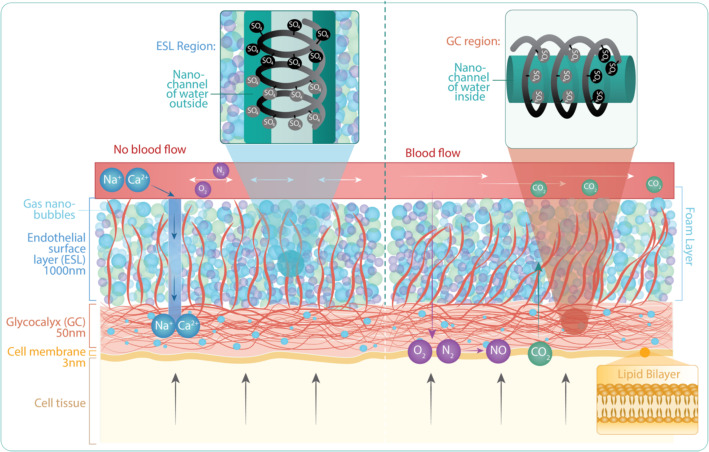
Diagram of a (dynamic) endothelial surface layer. (from bottom) The light-yellow region represents the interior of cells or of venous tissue. The thin yellow region is the lipid-protein bilayer cell boundary with the lipid component about 3 nm thick. The light red region is the glycocalyx typically 50 nm thick. Its principal components are the two sulphated polymers and about 10% of another hyaluronic acid polymer - adapted from [1] The arrows represent CO2 gas passing through the frit formed by the GC polymeric matrix to form a close-packed nanobubble foam (ESL region). The volume of non-gaseous bi-continuous connected liquid/polymer strand region can be as low as a few percent. The foam resists compression and repels red cells. As blood plasma flows past, nanobubbles slough off and join the circulation system and leave by exhalation from the lungs. The CO2 nanobubbles are lethal to viruses like COVID-19 [1,2,15] and [15] Oxygen/nitrogen circulating nanobubbles also pass through the glycocalyx and nitric oxide is formed therein via hydrophobic cavitation. Added by: Dr. Enrique Feoli Last edited by: Dr. Enrique Feoli |