BioAcyl Corp

BioAcyl Corp |
|
 |
 |
 |

|
Tao, N., Xu, X., & Ying, Y. (2023). Thymosin α1 and its role in viral infectious diseases: The mechanism and clinical application. Molecules, 28(8). Added by: Dr. Enrique Feoli (18/04/2023, 10:15) Last edited by: Dr. Enrique Feoli (18/04/2023, 10:22) |
 |
| Resource type: Journal Article Published DOI: 10.3390/molecules28083539 ID no. (ISBN etc.): 1420-3049 BibTeX citation key: Tao2023 View all bibliographic details  |
Categories: BioAcyl Corp Subcategories: Immuno stimulants Creators: Tao, Xu, Ying Collection: Molecules |
Views: 20/220
|
| Abstract |
|
Thymosin α1 (Tα1) is an immunostimulatory peptide that is commonly used as an immune enhancer in viral infectious diseases such as hepatitis B, hepatitis C, and acquired immune deficiency syndrome (AIDS). Tα1 can influence the functions of immune cells, such as T cells, B cells, macrophages, and natural killer cells, by interacting with various Toll-like receptors (TLRs). Generally, Tα1 can bind to TLR3/4/9 and activate downstream IRF3 and NF-κB signal pathways, thus promoting the proliferation and activation of target immune cells. Moreover, TLR2 and TLR7 are also associated with Tα1. TLR2/NF-κB, TLR2/p38MAPK, or TLR7/MyD88 signaling pathways are activated by Tα1 to promote the production of various cytokines, thereby enhancing the innate and adaptive immune responses. At present, there are many reports on the clinical application and pharmacological research of Tα1, but there is no systematic review to analyze its exact clinical efficacy in these viral infectious diseases via its modulation of immune function. This review offers an overview and discussion of the characteristics of Tα1, its immunomodulatory properties, the molecular mechanisms underlying its therapeutic effects, and its clinical applications in antiviral therapy.
|
| Notes |
|
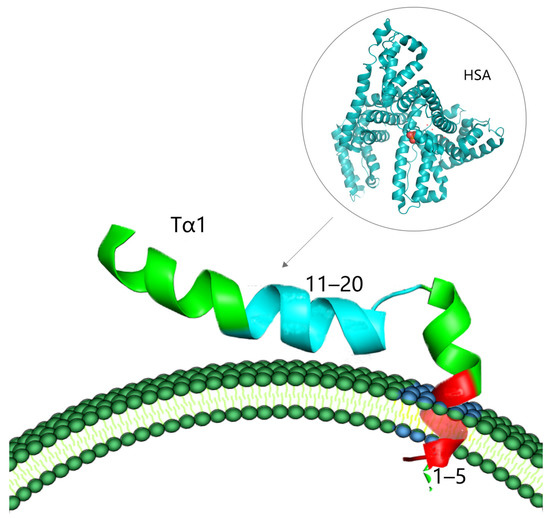
Possible interactions between Tα1 and the membrane (the dark blue part of the phospholipid bilayer is the negatively charged target membrane region after PS exposure, which is combined with the 1–5 amino acid residue sequence of the red part of Tα1; the 11–20 amino acid residue sequence of the blue part of Tα1 is the region interacting with HSA). Added by: Dr. Enrique Feoli Last edited by: Dr. Enrique Feoli |