BioAcyl Corp

BioAcyl Corp |
|
 |
 |
 |
|
Klose, C. S. N., & Artis, D. (2020). Innate lymphoid cells control signaling circuits to regulate tissue-specific immunity. JBC. Added by: Dr. Enrique Feoli (15/08/2020, 18:45) Last edited by: Dr. Enrique Feoli (19/08/2020, 20:33) |
 |
| Resource type: Miscellaneous Published DOI: 10.1038/s41422-020-0323-8 BibTeX citation key: Klose2020 View all bibliographic details  |
Categories: BioAcyl Corp, Innate immunity Subcategories: Inmunidad de mucosas Creators: Artis, Klose Publisher: JBC |
Views: 16/279
|
| Abstract |
|
The multifaceted organization of the immune system involves not only patrolling lymphocytes that constantly monitor antigen-presenting cells in secondary lymphoid organs but also immune cells that establish permanent tissue-residency. The integration in the respective tissue and the adaption to the organ milieu enable tissue-resident cells to establish signaling circuits with parenchymal cells to coordinate immune responses and maintain tissue homeostasis. Innate lymphoid cells (ILCs) are tissue-resident innate immune cells that have a similar functional diversity to T cells including lineage-specifying transcription factors that drive certain effector programs. Since their formal discovery 10 years ago, it has become clear that ILCs are present in almost every tissue but strongly enriched at barrier surfaces, where they regulate immunity to infection, chronic inflammation, and tissue maintenance. In this context, recent research has identified ILCs as key in orchestrating tissue homeostasis through their ability to sustain bidirectional interactions with epithelial cells, neurons, stromal cells, adipocytes, and many other tissue-resident cells. In this review, we provide a comprehensive discussion of recent studies that define the development and heterogeneity of ILC populations and their impact on innate and adaptive immunity. Further, we discuss emerging research on the influence of the nervous system, circadian rhythm, and developmental plasticity on ILC function. Uncovering the signaling circuits that control development and function of ILCs will provide an integrated view on how immune responses in tissues are synchronized with functional relevance far beyond the classical view of the role of the immune system in discrimination between self/non-self and host defense.
|
| Notes |
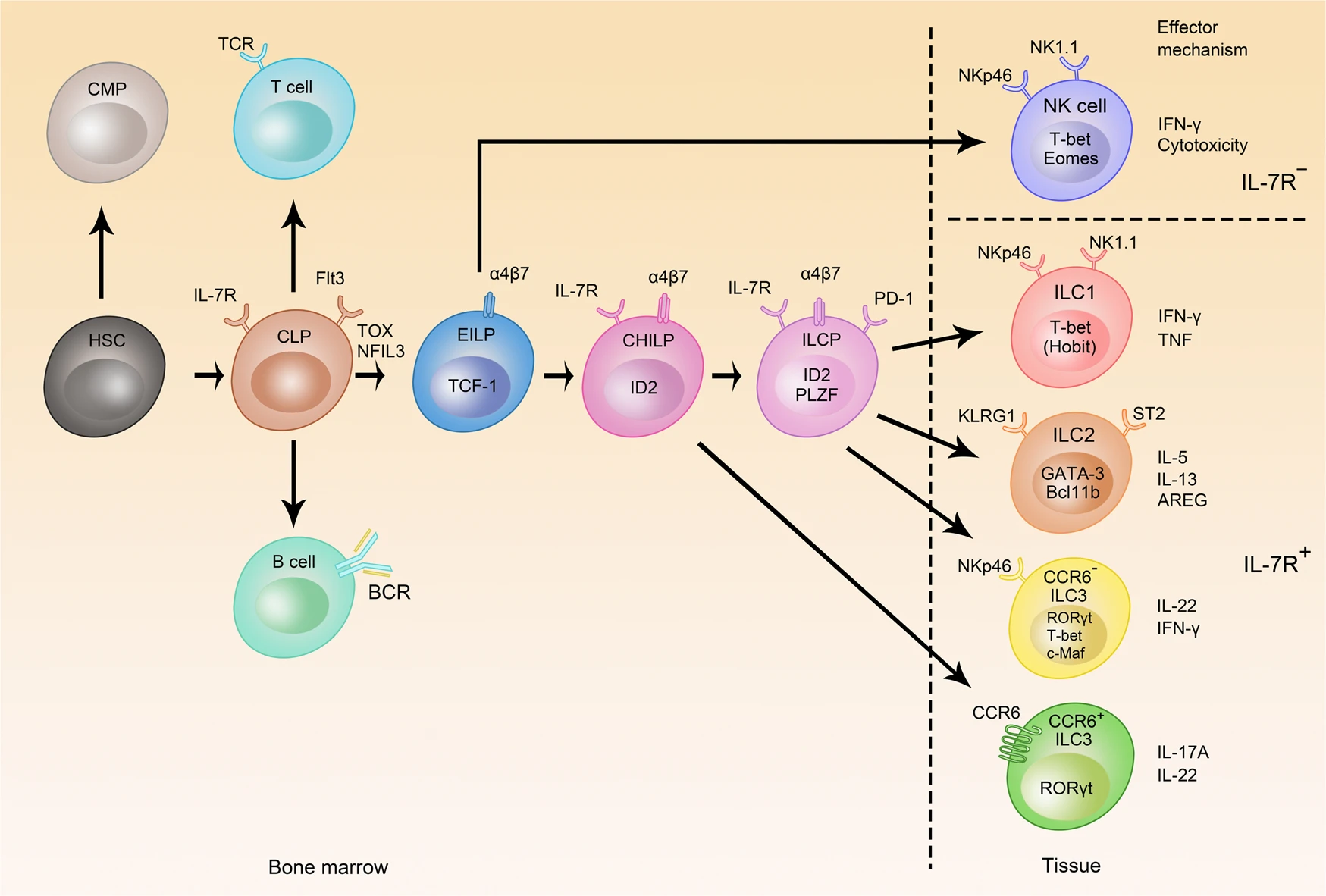
Development of ILCs.
The hematopoietic stem cell (HSC) is the source of all hematopoietic cells and give rise to the common myeloid progenitor (CMP) and common lymphoid progenitor (CLP), and CLP has the potential to develop into all lymphocytes. The early ILC progenitor (EILP) gives rise to all ILC subsets, whereas common helper-like ILC progenitor (CHILP) and the ILC progenitor (ILCP) still have multi-lineage potential but this is restricted to ILC1, ILC2, and ILC3 as indicated by arrows. Transcriptional requirements, phenotypical markers, and effector molecules of ILCs are shown (TCR T cell receptor, BCR B cell receptor). Added by: Dr. Enrique Feoli Last edited by: Dr. Enrique Feoli |