BioAcyl Corp

BioAcyl Corp |
|
 |
 |
 |
|
Byrd, K. M., Huang, N., & Perez, P. (2020). Integrated Single-Cell Atlases Reveal an Oral SARS-CoV-2 Infection and Transmission Axis. medRxiv, 2020.10.26.20219089. Added by: Dr. Enrique Feoli (29/10/2020, 10:54) Last edited by: Dr. Enrique Feoli (21/10/2023, 17:47) |
 |
| Resource type: Journal Article BibTeX citation key: Byrd2020 View all bibliographic details  |
Categories: BioAcyl Corp Subcategories: Inmunidad de mucosas Creators: Byrd, Huang, Perez Collection: medRxiv |
Views: 4/307
|
| Abstract |
|
Despite signs of infection, the involvement of the oral cavity in COVID-19 is poorly understood. To address this, single-cell RNA sequencing datasets were integrated from human minor salivary glands and gingiva to identify 11 epithelial, 7 mesenchymal, and 15 immune cell clusters. Analysis of SARS-CoV-2 viral entry factor expression showed enrichment in epithelia including the ducts and acini of the salivary glands and the suprabasal cells of the mucosae. COVID-19 autopsy tissues confirmed in vivo SARS CoV-2 infection in the salivary glands and mucosa. Saliva from SARS-CoV-2-infected individuals harbored epithelial cells exhibiting ACE2 expression and SARS-CoV-2 RNA. Matched nasopharyngeal and saliva samples found distinct viral shedding dynamics and viral burden in saliva correlated with COVID-19 symptoms including taste loss. Upon recovery, this cohort exhibited salivary antibodies against SARS-CoV-2 proteins. Collectively, the oral cavity represents a robust site for COVID-19 infection andimplicates saliva in viral transmission.
|
| Notes |
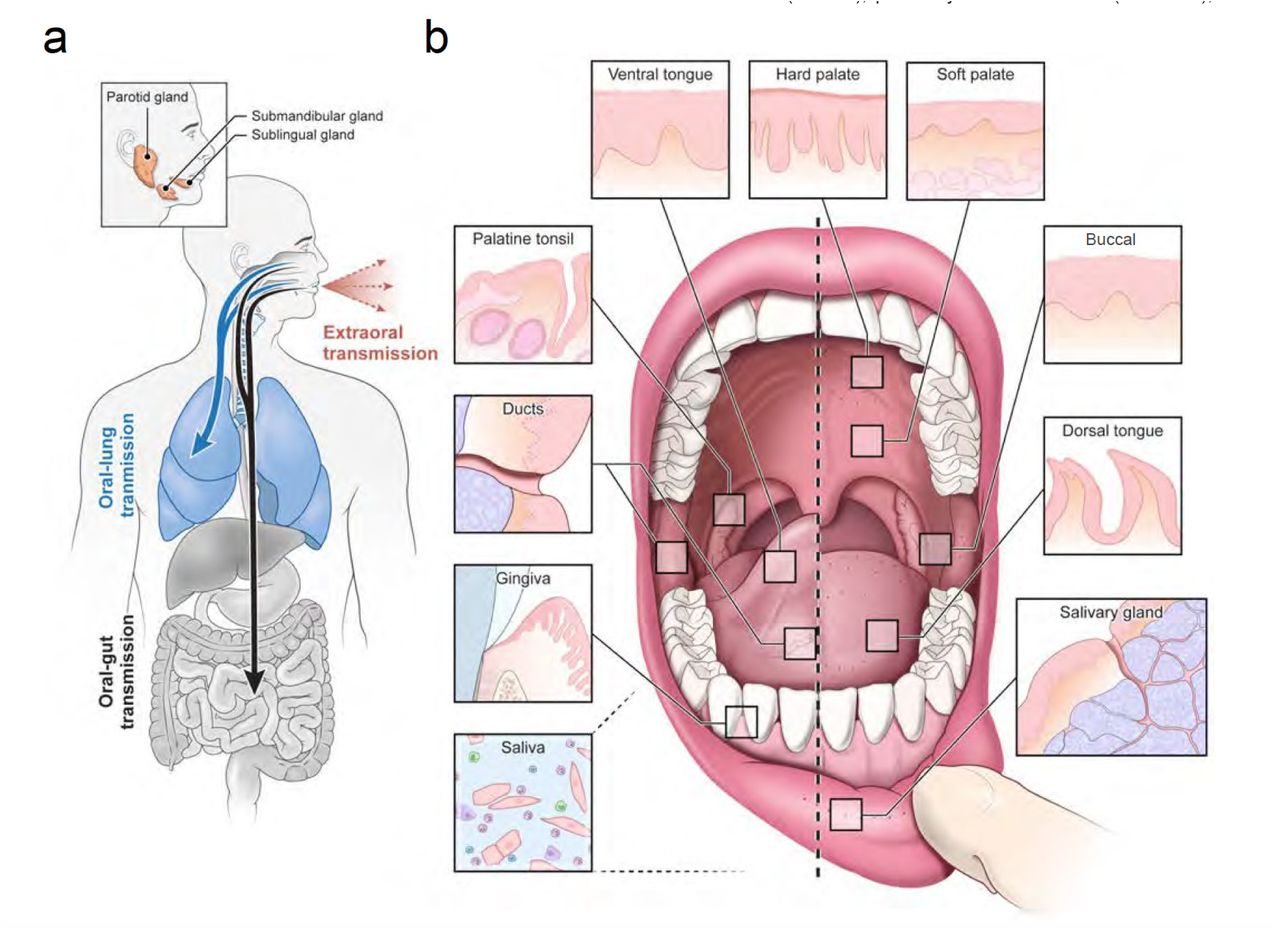
An infection and transmission axis for SARS-CoV-2 among distinct oral niches. (a) The contribution of the oral cavity to COVID-19 pathogenesis and transmission has been little explored. It is unknown whether SARS-CoV-2 can infect and replicate in the oral mucosa or glands. This is critical because if the glands or mucosa are sites of early infection, they may play an important and underappreciated role in transmitting virus “intermucosally” to the lungs or gastrointestinal tract. Alternatively, saliva may also play a central role in transmitting the virus extraorally in asymptomatic, pre-symptomatic, or symptomatic individuals. (b) The human oral cavity is a diverse collection of tissue niches with potentially unique vulnerabilities to viral infection. These sites include oral mucosae (hard palate, buccal mucosa, dorsal and ventral tongue) as well as the also the terminally differentiated secretory epithelia of the minor saliva glands (distributed in the buccal and labial mucosa, hard and soft palate, ventral and dorsal tongue) and major saliva glands (parotid, submandibular, and sublingual). Nearby are diverse oropharyngeal niches (palatine and lingual tonsils, soft palate). Saliva, a mixture of fluids, electrolytes, proteins, and cells (immune and sloughed mucosal epithelial cells) is made primarily by the saliva glands and empties into the oral cavity where it mixes with other fluids (crevicular fluid) and cells. |