BioAcyl Corp

BioAcyl Corp |
|
 |
 |
 |
|
Decker, T. (2021). The early interferon catches the sars-cov-2. Journal of Experimental Medicine, 218(10). Added by: Dr. Enrique Feoli (02/09/2021, 15:00) Last edited by: Dr. Enrique Feoli (02/09/2021, 15:22) |
 |
| Resource type: Journal Article Published DOI: 10.1084/jem.20211667 ID no. (ISBN etc.): 0022-1007 BibTeX citation key: Decker2021 View all bibliographic details  |
Categories: BioAcyl Corp Subcategories: COVID-19 Creators: Decker Collection: Journal of Experimental Medicine |
Views: 16/274
|
| Abstract |
|
Interferons establish innate antiviral immunity. Two recent papers in JEM by Lopez et al. (2021. J. Exp. Med.https://doi.org/10.1084/jem.20211211) and Cheemarla et al. (2021. J. Exp. Med.https://doi.org/10.1084/jem.20210583) show that an appropriate supply of antiviral interferon enables epithelial cells of the nasopharyngeal mucosa to inhibit SARS-CoV-2 growth and that interferon-induced mucosal genes serve as biomarkers of infection.
|
| Notes |
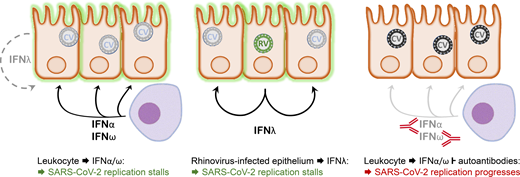
Model depicting the interaction between SARS-CoV-2 and the nasopharyngeal epithelium. Left: In a situation of asymptomatic infection or mild disease, mucosal leukocytes provide the IFN-I IFNα and IFNω for an inhibitory antiviral state. IFNλ production by the infected cells alone is insufficient in this situation. Middle: Infection with an RNA virus such as rhinovirus causes epithelial cells to produce sufficient IFNλ to cause an antiviral state in bystander cells that subsequently lose permissiveness for SARS-CoV-2 replication. Right: As in the left panel, but autoantibodies inhibit the leukocyte-derived IFN. Consequently, the epithelium remains permissive for SARS-CoV-2 replication, allowing for virus spread to the lower respiratory tract and favoring the development of severe pulmonary disease.
Added by: Dr. Enrique Feoli Last edited by: Dr. Enrique Feoli |